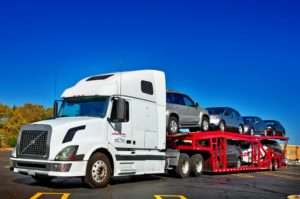
Open car shipping costs $600–$1,800 and uses a standard multi-car hauler exposed to the elements — the right choice for 95% of vehicles. Enclosed car shipping costs $1,000–$3,500 and uses a fully covered trailer, providing maximum protection for luxury, exotic, classic, or high-value vehicles. The choice comes down to your vehicle’s value, your risk tolerance, and your budget.
Open vs Enclosed Car Shipping: The Core Difference
When you ship a car across the country, your vehicle travels on one of two types of trailers: open or enclosed. The vast majority of auto transport in the United States — over 90% — uses open transport. It’s safe, efficient, cost-effective, and completely appropriate for most vehicles.
Enclosed transport is a premium service used for a specific category of vehicles where the cost of damage, even minor cosmetic damage, significantly outweighs the cost of the upgraded trailer. If you own a Ferrari, a 1969 Camaro in show condition, or a fully custom-wrapped luxury SUV, enclosed transport isn’t a luxury — it’s insurance.
Let’s break down exactly what each method involves, what it costs in 2026, when each makes sense, and how to make the right call for your specific vehicle.
What Is Open Car Transport?
Open car transport is the standard method for shipping vehicles across the country. Your vehicle is loaded onto a multi-level, open-air auto transport trailer — the same kind of hauler you see driving down the interstate loaded with new cars headed to dealerships. These trailers typically carry 7–10 vehicles simultaneously.
How Open Transport Works
When you book open transport with Ultimate Transport 123, here’s what happens:
- Carrier dispatched to your location: An open transport carrier with space on a route matching yours is assigned to your vehicle. Pickup is typically within 1–5 days of your requested window.
- Vehicle inspection and loading: The driver walks around your vehicle with you, documents all pre-existing condition on the Bill of Lading, and loads your car onto the hauler using hydraulic ramps.
- Transit: Your vehicle travels with 6–9 other vehicles on the same trailer toward your destination. Drivers often make multiple pickups and deliveries along the route.
- Delivery and inspection: At the destination, you inspect the vehicle together with the driver, compare to the original Bill of Lading, and confirm delivery.
What Open Transport Exposes Your Vehicle To
Being open means the vehicle is exposed to ambient road conditions during transit: weather (rain, sleet, snow, sun, wind), occasional road debris from passing vehicles or construction zones, and road film requiring a post-delivery wash. For a standard production vehicle, none of these represent meaningful risk. Millions of vehicles ship open transport every year without incident.
What Is Enclosed Car Transport?
Enclosed car transport uses a fully covered trailer — either a hard-sided box trailer or a soft-sided curtain trailer — that completely shields vehicles from weather, debris, and visual exposure. Enclosed trailers typically carry 2–6 vehicles, and the best enclosed operators run 2-car trailers for maximum protection and white-glove handling.
Types of Enclosed Trailers
| Trailer Type | Capacity | Protection Level | Best For |
|---|---|---|---|
| Hard-sided box (single level) | 2–4 vehicles | Maximum — fully sealed | Exotics, ultra-high-value vehicles |
| Hard-sided box (double level) | 4–6 vehicles | Excellent — fully sealed | Luxury, classic, collector vehicles |
| Soft-sided curtain trailer | 4–7 vehicles | Good — weather protected | Luxury vehicles, collector cars |
| Climate-controlled enclosed | 1–4 vehicles | Maximum + temperature controlled | Irreplaceable exotics, museum-quality classics |
Additional Enclosed Transport Features
Premium enclosed carriers often include soft tie-downs (no metal chain contact with wheels), lift gates for ultra-low ground-clearance vehicles, professional photo documentation, GPS tracking, and higher cargo insurance — typically $500,000–$1,000,000 vs. the $100,000 standard for open carriers.
Open vs Enclosed Car Shipping: Cost Comparison (2026)
Here are 2026 real-market rates for both transport methods by route distance:
| Route Distance | Open Transport | Enclosed Transport | Enclosed Premium |
|---|---|---|---|
| Under 500 miles | $400 – $800 | $700 – $1,300 | +50–75% |
| 500 – 1,000 miles | $700 – $1,100 | $1,100 – $1,800 | +40–65% |
| 1,000 – 1,500 miles | $900 – $1,300 | $1,400 – $2,200 | +40–60% |
| 1,500 – 2,000 miles | $1,100 – $1,600 | $1,700 – $2,700 | +40–60% |
| 2,000 – 2,500 miles | $1,300 – $1,900 | $2,000 – $3,100 | +40–65% |
| 2,500+ miles coast-to-coast | $1,500 – $2,200 | $2,300 – $3,500 | +40–60% |
Rates reflect 2026 national open market averages for standard sedans and SUVs under 6,000 lbs. Call 1-888-885-9123 for a guaranteed quote on your specific vehicle and route.
Why Does Enclosed Cost 40–75% More?
Three structural cost drivers explain the premium. First, fewer vehicles per load: an enclosed trailer carries 2–6 vehicles vs. 7–10 on open, so fixed costs are divided among fewer revenue-generating spots. Second, higher insurance requirements: cargo coverage for a trailer carrying $400,000 in luxury vehicles is substantially more expensive than coverage for $80,000 in standard vehicles. Third, specialized equipment: enclosed trailers, lift gates, and soft tie-down systems are more expensive to purchase and operate than standard open-air haulers.
Which Vehicles Should Use Open Transport?
Open transport is the right choice for the overwhelming majority of vehicle shipments. The open transport profile: any standard production vehicle that is replaceable and where market value — not irreplaceability — is the primary financial concern.
- Sedans and coupes: Honda Civic, Toyota Camry, Ford Fusion, Hyundai Elantra
- SUVs and crossovers: Toyota RAV4, Ford Explorer, Chevrolet Suburban, Jeep Grand Cherokee
- Pickup trucks: Ford F-150, Chevrolet Silverado, Ram 1500, Toyota Tacoma
- Minivans: Honda Odyssey, Chrysler Pacifica
- Electric vehicles: Tesla Model 3, Model Y, standard Model S and Model X
- Modern luxury vehicles under $60,000–$80,000: BMW 3 Series, Mercedes C-Class, Audi A4
Which Vehicles Should Use Enclosed Transport?
Use enclosed transport when the cost of any cosmetic damage significantly exceeds the premium cost of the enclosed trailer:
Exotic and Supercar Vehicles (Enclosed Required)
- Ferrari (all models), Lamborghini, McLaren, Bugatti, Koenigsegg
- Porsche 911 GT3/GT3 RS, 918 Spyder, Carrera GT
- Aston Martin, Bentley, Rolls-Royce, Maserati MC20
Classic and Collector Vehicles (Enclosed Recommended)
- Pre-1980 vehicles in show, concours, or professional restoration condition
- Vehicles with custom paint, full respray, or PPF wrap covering the entire vehicle
- Muscle cars of significant value: Shelby Cobra, Boss 429, first-gen Corvette Stingray
- SEMA or custom show cars
High-Value Modern Vehicles (Enclosed Strongly Recommended)
- BMW M3/M4/M5/M8 Competition, Mercedes-AMG GT, E63 S, G63
- Porsche 911 Turbo S, Cayenne Turbo GT, Panamera Turbo S
- Audi RS e-tron GT, R8 V10 Performance
- Tesla Model S Plaid, Model X Plaid (values above $100,000)
- Any vehicle valued above $80,000–$100,000
The $80,000 Value Threshold: A Practical Rule
If your vehicle is worth more than $80,000, the enclosed premium is almost always worth paying. Here’s the math: a $120,000 vehicle shipping 1,500 miles costs $1,100 open vs. $1,800 enclosed — a $700 difference. A single rock chip on a carbon fiber hood that costs $2,500 to repair makes that $700 premium an obvious decision. Below $80,000, open transport’s safety record makes the statistical case for open.
Open vs Enclosed: Full Side-by-Side Comparison
| Feature | Open Transport | Enclosed Transport |
|---|---|---|
| Cost (1,000 miles, standard vehicle) | $900 – $1,200 | $1,400 – $2,000 |
| Weather exposure | Yes — rain, sun, wind | No — fully protected |
| Road debris exposure | Minimal but possible | None |
| Vehicles per trailer | 7–10 | 2–6 |
| Carrier availability | Very high | Moderate — specialty carriers |
| Pickup wait time | 1–5 days | 2–7 days |
| Cargo insurance | Standard ($100K) | Premium ($500K–$1M) |
| Soft tie-downs | Not standard | Standard practice |
| Lift gate loading | Not available | Available on request |
| Best for vehicle value | Under $60K–$80K | $80K+ or irreplaceable |
| Share of US auto transport | ~92% | ~8% |
Common Misconceptions About Open Car Transport
Misconception: Open Transport Is Dangerous for My Car
Open transport is the same method used to deliver virtually every new car from factory to dealership. The US auto transport industry moves approximately 15 million vehicles per year via open transport. The damage rate on open transport — when using a licensed, properly insured carrier — is well under 1% of transports. Most disputes involve pre-existing condition disagreements at delivery, not actual transit damage.
Misconception: Enclosed Guarantees Zero Damage
Enclosed transport significantly reduces exposure to weather and debris. It does not make damage impossible. Mechanical failures during loading or unloading and improperly secured vehicle restraints can affect enclosed vehicles. The advantage of enclosed is meaningful risk reduction, not absolute risk elimination.
Misconception: I Should Always Pay More for Enclosed to Be Safe
Paying for enclosed transport on a 2019 Honda Accord is like buying comprehensive insurance on a $4,000 car. The math doesn’t work. Open transport for a standard production vehicle is the appropriate risk management decision — not a compromise or a shortcut.
How to Choose: A Simple Decision Framework
Answer these three questions to determine your transport method:
- Is your vehicle valued above $80,000? If yes → enclosed transport.
- Is your vehicle a classic, collector, show, or irreplaceable vehicle? If yes → enclosed transport.
- Does your vehicle have custom paint, full PPF wrap, or significant cosmetic investment that would be expensive to repair? If yes → consider enclosed transport.
If you answered no to all three: open transport is the right choice for your vehicle.
Frequently Asked Questions: Open vs Enclosed Car Shipping
Is open or enclosed car transport safer?
Both methods are safe for the vast majority of vehicles. Open transport has a damage rate under 1% and is used to deliver virtually all new cars from factory to dealership. Enclosed transport provides additional protection from weather and road debris for high-value, classic, or exotic vehicles. For standard production vehicles, open transport is entirely safe and the statistically appropriate choice.
How much more does enclosed car shipping cost than open?
Enclosed car shipping costs 40–75% more than open transport on the same route. For a 1,000-mile shipment, open transport runs $900–$1,200 while enclosed runs $1,400–$2,000. The premium reflects fewer vehicles per trailer, higher cargo insurance requirements, and specialized equipment and handling costs.
What vehicles should use enclosed car transport?
Enclosed transport is recommended for exotic and supercar vehicles (Ferrari, Lamborghini, McLaren), classic and collector vehicles in show or restoration condition, high-value modern vehicles above $80,000–$100,000, and vehicles with custom paint, PPF wraps, or significant cosmetic investment. For all other standard production vehicles, open transport is the appropriate and safe method.
Can I ship a Tesla on an open carrier?
Yes. Tesla Model 3, Model Y, and standard Model S and Model X vehicles ship safely on open carriers routinely. For Tesla Model S Plaid and Model X Plaid (values above $100,000), enclosed transport is strongly recommended. Discuss specific concerns about custom wraps or vehicle-specific hardware at booking.
Does open transport include insurance if my car is damaged?
Yes. Licensed auto transport carriers are required by FMCSA regulations to carry cargo insurance. Open carriers typically carry $100,000 in cargo coverage. If your vehicle sustains damage during transit caused by the carrier, their cargo insurance covers the repair. Always document all pre-existing condition on the Bill of Lading at pickup — this is your legal protection in any damage claim.
Get a Quote for Open or Enclosed Car Shipping Today
Whether you need open transport for a standard vehicle or enclosed transport for a prized collector car, Ultimate Transport 123 handles both — with licensed carriers, locked-in pricing, and door-to-door delivery to all 48 contiguous states.
- Call us at 1-888-885-9123 — tell us your vehicle and route and we’ll match you with the right transport method
- Get your free instant quote online — select open or enclosed at checkout
- Browse our full auto transport services — route coverage, transit times, and FAQs
Our pricing is guaranteed and all-in — no surprise fuel surcharges, no re-trading at pickup. The quote you receive is the price you pay. Available 7 days a week.
Related posts:
- Online Car Buying & Auto Transport FAQ 2026: Shipping Your Vehicle from Carvana, CarMax, Facebook Marketplace & Private Sellers
- April 2026 Gas Prices Hit $3.75/Gallon: Which Routes Are Still Profitable (And Which Ones Cost You Money)
- EV Shipping Insurance Costs in 2026: Why Tesla & Rivian Owners Pay 2-3x More (And How to Quote Confidently)
- Why Your Auto Transport Quote Seems Too High: 2026 Breakdown of Hidden Fees, Route Premiums & What You Can Actually Negotiate
- April 2026 Fuel Surcharges and Hidden Costs Explained